Lesson of the Day 109: The Fabric Box — Montessori's Tactile Lesson in Matching Textures by Touch
Published on: June 22, 2026
📄 Free printable: The Fabric Box — Presentation & Sequence Cards (PDF) — a step-by-step presentation guide and a starter set of textures, ready to print for home or classroom.
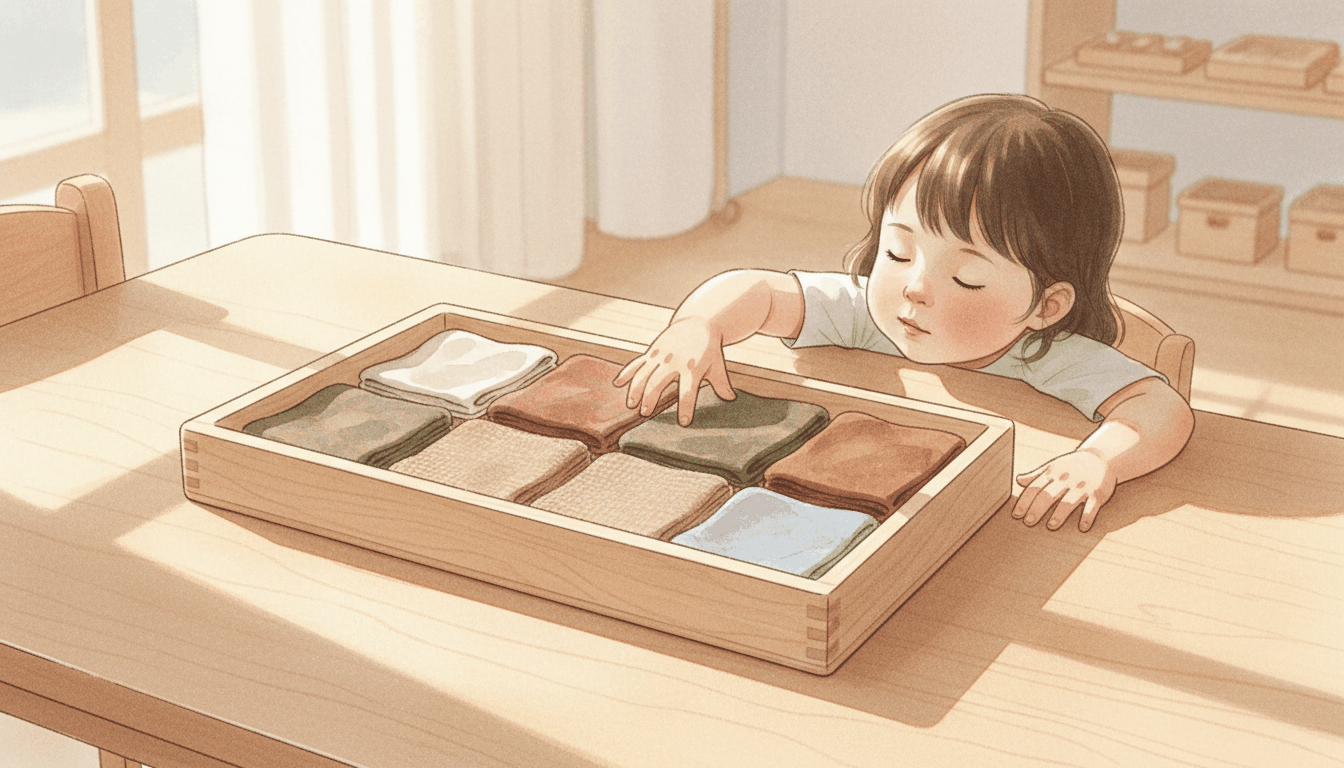
There is a particular kind of quiet that settles over a child when they close their eyes and reach into a box of folded cloth. The world narrows. The chatter in their mind softens. All that remains is the meeting of fingertips and fabric — the cool slip of satin, the dry tooth of burlap, the comforting nap of velvet. This is the gentle magic of the Fabric Box, and it is one of the most beloved tactile lessons in the Montessori sensorial sequence. Today, let's explore how to bring it into your home.
If you've been following along with our Lesson of the Day series, you'll recognize the Fabric Box as a close cousin of the materials we've already met. But even if this is your first introduction, don't worry — it's one of the simplest and most affordable lessons to prepare, and it rewards your child with a skill that quietly underpins so much of how they come to know the physical world.
What Is the Fabric Box?
The Fabric Box is exactly what it sounds like: a small box or basket holding pairs of fabric swatches, each pair cut from a different material. Cotton, silk, wool, velvet, corduroy, burlap, denim, linen, satin — the variety is up to you. The child's work is to match the pairs by touch alone, usually while blindfolded or with eyes closed.
What looks like a simple matching game is, in truth, a refined exercise in tactile discrimination. By removing sight, we isolate one sense and ask it to do all the work. The child can no longer rely on the obvious visual cues of color and pattern. Instead, they must attend to texture, weight, weave, temperature, and the way a fabric drapes or resists. This isolation of a single sense is a hallmark of Montessori sensorial work — it is precisely what allows the child's perception to sharpen and deepen.
The Stereognostic Sense: Knowing Through Touch
Dr. Montessori made a careful distinction between two layers of the sense of touch. The first is the purely tactile sense — the skin's perception of texture, smoothness, roughness, and temperature. The second is what she called the stereognostic sense: the ability to recognize and identify objects through touch and movement combined, without seeing them. It's the sense you use when you fish your keys out of a cluttered bag without looking, or recognize a coin by its milled edge.
The Fabric Box develops both layers. When a child runs their fingers across a swatch, they gather tactile impressions. When they hold a piece, rub it between thumb and forefinger, feel its body and drape, and then search their memory for its match, they are exercising the stereognostic sense — building a mental library of textures and learning to compare against it. This is sophisticated cognitive work dressed up as play.
If you'd like a fuller picture of why this matters and how it connects to everything else on your shelves, our overview of Montessori sensorial education lays out the philosophy behind isolating and refining each sense one at a time.
Materials: How to Make or Buy a Fabric Box
This is wonderful news for the budget-conscious parent: the Fabric Box is one of the easiest sensorial materials to make at home. You almost certainly have what you need already.
To assemble your own, you'll want:
- A shallow box, basket, or tray to hold the swatches
- Pairs of fabric — start with three or four clearly contrasting textures, such as silk, burlap, velvet, and corduroy
- Pinking shears (the zigzag scissors) to keep the edges from fraying
- A blindfold or simple eye mask, if your child enjoys using one
Cut two identical squares of each fabric, roughly four inches across. Consistency in size matters — you want the child distinguishing texture, not size or shape. Raid your sewing basket, an old garment you were going to donate, or the remnant bin at a fabric store, where small cuts are often sold for pennies.
If you'd rather not assemble your own, or you're building out a fuller sensorial shelf, a ready-made Montessori First Fabric Box with 12 tactile fabric pairs can save you the prep and gives you beautifully consistent, machine-cut pieces from the start. And once your child has mastered matching those, the Montessori Second Fabric Box of finer-textured pairs extends the lesson with more subtle distinctions for refined touch.
Whether you buy or make, choose textures that contrast clearly at first. A child who is asked to distinguish two nearly identical cottons will only grow frustrated. Begin with the obvious — slippery against scratchy, plush against stiff — and refine from there.
The Three-Period Presentation
Like most Montessori lessons, the Fabric Box is best introduced slowly, with few words and many graceful, deliberate movements. Sit beside your child, not across from them, so they see the work from your perspective. Here is how the presentation unfolds.
Step One: Invite and Prepare
Carry the box to the table or mat with care, modeling the respect you have for the material. Take out two contrasting pairs — say, silk and burlap — and lay the four swatches in a row. Tell your child, "Today I'm going to feel these fabrics with my fingers." Demonstrate slowly: stroke each piece with the pads of your fingers, perhaps closing your eyes to show that this is a touching exercise, not a looking one.
Step Two: The First Period — Naming the Sensation
Run your fingers over the silk and say, "This feels smooth." Run your fingers over the burlap and say, "This feels rough." Invite your child to feel each one and echo the sensation. Keep your language sparse and precise. You are linking a felt experience to a word, and the fewer distractions, the better the bond.
Step Three: The Second Period — Recognizing
Now ask your child to find a sensation by touch. "Can you show me the smooth one? Can you find the rough one?" This is the longest and most playful stage. Let them feel, hesitate, change their minds. Resist the urge to correct or hurry. If they enjoy it, introduce the blindfold here, and watch how their attention turns inward.
Step Four: The Third Period — Producing the Word
Finally, hand your child a swatch and ask, "How does this one feel?" Here they supply the word themselves — "smooth" or "rough." Only move to this stage when the first two feel secure. If they stumble, simply step back to naming and recognizing without comment. There is never any rush.
Step Five: Matching the Pairs
Once the vocabulary is comfortable, the heart of the work begins. With eyes closed or blindfolded, your child takes one swatch, explores it, then searches the others to find its twin. They set matched pairs aside and continue until all the fabrics are reunited. Then — and this is the satisfying part — they open their eyes to see how they did.
Control of Error
One of the quiet geniuses of Montessori materials is that the child can check their own work without an adult's verdict. With the Fabric Box, the control of error lives in the child's own sense of sight. After matching by touch, they simply look. If two swatches are truly identical, the match is confirmed. If a stiff denim has been paired with a soft flannel, the eyes reveal the mismatch instantly, and the child can try again.
This self-correction is precious. It preserves your child's dignity and independence. You are not the authority handing down right and wrong; the material itself offers honest, immediate feedback. Your job is to step back and trust the process.
Extensions and Variations
Once the basic matching is mastered, the Fabric Box opens into all sorts of delightful directions:
- Grading by texture. Instead of matching identical pairs, line up swatches from roughest to smoothest, creating a tactile gradient. This is more demanding and beautifully refines discrimination.
- The mystery bag. Place the swatches in a drawstring bag and have your child name each fabric by feel before pulling it out — a pure stereognostic challenge.
- Real-world hunts. Send your child around the house to find something silky, something woolly, something scratchy. This carries the lesson off the shelf and into daily life.
- Naming the materials. For an older child, attach the proper names — velvet, corduroy, linen — and even discuss where each comes from. The Fabric Box becomes a doorway to a study of textiles and the natural world.
Age and Readiness
Most children are ready for the Fabric Box somewhere between three and four years old, though readiness matters far more than the number on the calendar. Look for a child who can sit with a focused activity for a few minutes, who is curious about how things feel, and who has perhaps already enjoyed earlier sensorial work.
A child who isn't yet ready will tell you plainly — by wandering off, by peeking under the blindfold, by losing interest. None of these are problems. They are simply information. Quietly return the box to the shelf and offer it again in a few weeks. The beauty of a prepared environment is that the work waits patiently for the child to grow into it.
Where the Fabric Box Fits in the Sensorial Sequence
The Fabric Box rarely stands alone. It belongs to a whole family of materials, each devoted to refining a single sense. Children often come to fabric matching after they've delighted in the visual dimension work of the classic Pink Tower, where they grade ten cubes from largest to smallest and build their visual discrimination.
On the tactile branch of the family, the Fabric Box sits beside the Baric Tablets, which teach the discrimination of weight by touch — the difference between a heavy hardwood and a light balsa. And on the auditory branch, you'll find the Sound Boxes that develop the sense of hearing through matching paired sounds. Together these materials build a child who notices the world in extraordinary detail — a child whose senses have been not just used, but educated.
Each lesson reinforces a single, simple Montessori idea: that the path to the intellect runs through the hand and the senses. Before a child can classify, compare, and reason in the abstract, they must first gather rich, ordered impressions of the concrete world. The Fabric Box is one humble, lovely brick in that foundation.
A Gentle Word as You Begin
You don't need a perfect material, a quiet classroom, or a degree to offer this lesson well. You need a handful of fabric squares, a little patience, and a willingness to slow down and let your child do the discovering. Set out the box, demonstrate with care, and then — perhaps the hardest part — trust your child's fingertips to do their work. Watch their face soften in concentration. That focused calm is the whole point.
Begin with just three pairs this week. See where your child's curiosity leads. You may be surprised how quickly those small hands learn to read the world by touch.