Handwork Activities — Cutting & Fine Motor
Published on: June 01, 2012
Handwork Activities — Cutting & Fine Motor
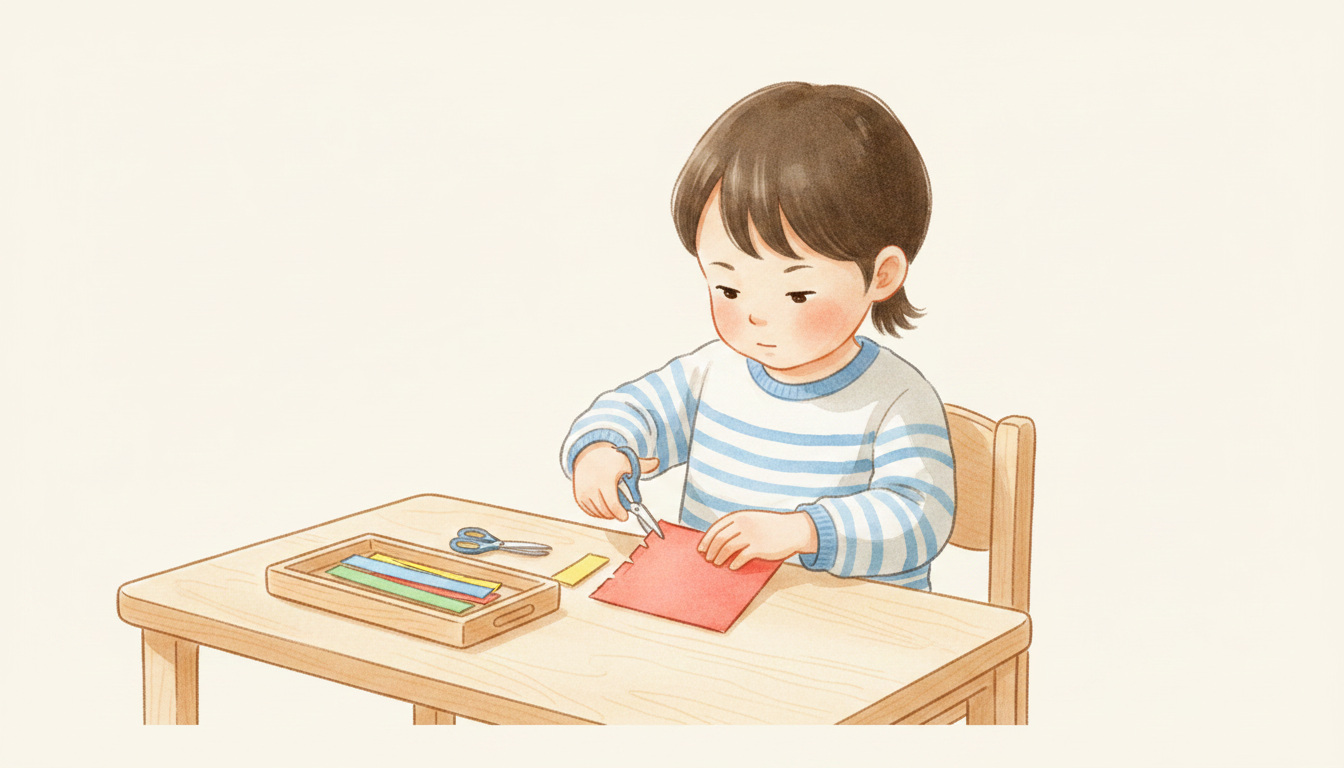
In Montessori training, you quickly learn that the word we use for the preschool classroom is not art — it is handwork. Handwork covers all the purposeful, hands-on activities that build a child's coordination, concentration, and creativity: cutting, tearing, gluing, sewing, weaving, and working with clay. Of all of these, learning to cut with scissors is one of the most satisfying — and one of the most important — fine-motor skills a young child can practice.
Montessori Connection: Cutting is a true practical-life exercise. It isolates a single skill, gives the child a clear beginning and end, and lets them see real results from their own effort. The careful opening and closing of the scissors strengthens exactly the hand muscles a child will later use for writing, while the focus required builds concentration. As with all Montessori work, we move from the simple to the complex and let the child repeat the activity as many times as they wish.
Materials
You don't need much to begin — just a good pair of child-sized safety scissors and some paper your child is free to cut up. A small tray keeps everything tidy and helps the child carry the work to a table independently.
- Fiskars Training Scissors for Kids 3+ (easy-grip, blunt-tip — what we use)
- A wooden Montessori cutting / practical-life set for the tray
- A basket of paper to cut: construction paper, old magazines, tissue paper, junk mail
- A small tray or basket to hold the work
Cutting 101 — Five Steps for Cutting Paper
Cutting is a process that takes time to learn. Offer these five stages in order, and let your child stay with each one until it feels easy before moving on.
- Fringe a border. Let your child make small snips along the edge of a strip of paper. This is the very first cut — short, simple, and successful.
- Cut a straight line. Draw a bold line and let your child cut along it.
- Cut a curved line. Add a gentle curve to follow.
- Cut out shapes. Circles, triangles, squares, and rectangles.
- Cut out figures. Paper dolls, numbers, letters, and pictures from magazines or coloring books.
If your child is not yet ready for scissors, begin with tearing. Snip the edge of the paper first so it is easier to tear, and let your child pull it apart with their fingers. Tissue paper is wonderful for this early tearing exercise.
Kitchen Scissors — Cutting in Real Life
Cutting herbs is a wonderful sensory experience for grown-ups and children alike. My own children used their safety scissors to cut herbs for our meals. Chinese and onion chives are especially easy for little hands to snip into small pieces, and stripping leaves off a stem of herbs is a perfect job for a young child — it's perfectly fine if they use their fingers too.
Scissors are useful all over the kitchen: snip sliced bread into bread crumbs, cut cheese slices into squares, and shred leaf lettuce for a salad. Real work with a real purpose is the heart of practical life.
Handwork & Art on a Budget
During my first year teaching we used traditional Montessori art supplies from Nienhuis. The papers and paints were beautiful — but very expensive. The next year our budget was cut, and we had to rethink everything. Honestly? It turned out to be much more fun to use what we already had in creative ways.
While studying clouds, we provided recycled cotton, clean grocery trays, and glue to make different kinds of clouds. Instead of plasticine, we made our own fun dough, peanut butter dough, and paper-mâché clay. We made cardboard looms from stationery boxes and used packing foam — which works far better than felt — for first sewing lessons. Recycling what you have on hand turns handwork into a true lesson in creativity.
For more of our favorite homemade supplies and projects, see Art Recipes, our list of free art supplies, and simple and fun painting ideas. Cutting and handwork also fit beautifully alongside the rest of your early practical life and practical life work.
I believe handwork and art are some of the best free play there is for young children. Keep a variety of materials within reach for both academic and creative work — art truly calms the soul.