Number Rods Printout
Published on: June 30, 2007
Number Rods Printout
In the Montessori method, number rods are one of the earliest and most powerful sensorial materials for helping children understand quantity and sequence. They’re a bridge between the rich sensorial exploration your child has already been doing and the world of abstract mathematics that lies ahead. By holding, comparing, and counting these beautifully simple rods, your little one begins to grasp that numbers represent real, tangible quantities that can be seen, touched, and arranged.
What Are Number Rods?
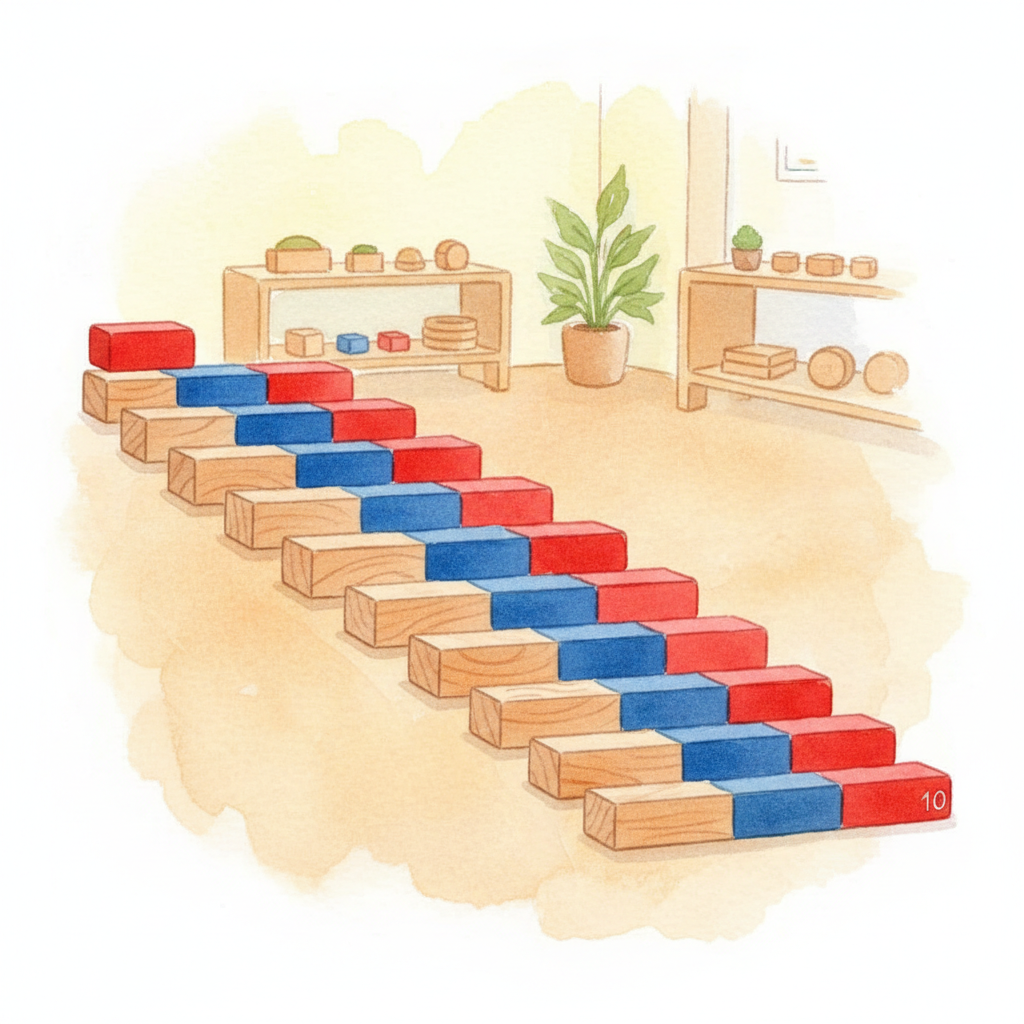
Number rods are a set of ten rods, each divided into alternating red and blue segments. The shortest rod is just one unit long, while the longest stretches to ten units. They build directly upon the Red Rods from the sensorial curriculum, adding an exciting new dimension: counting. Each alternating color segment represents one unit, so your child can see and feel that “four” is literally four segments long. There’s no memorization required—quantity becomes concrete rather than abstract. This is a perfect example of how Montessori math moves from concrete to abstract so naturally. Your child isn’t being told what “seven” means; they’re experiencing it with their own hands.
How to Use Number Rods
Presenting the number rods is a joyful experience. The steps below will help you guide your child with confidence.
- Step 1 – Lay out the rods: Arrange all ten rods randomly on a mat. Invite your child to find the shortest and longest rods, letting them explore freely.
- Step 2 – Build the stair: Guide your child to arrange the rods from shortest to longest, creating a staircase pattern just as they did with the Red Rods.
- Step 3 – Introduce counting: Starting with the one-rod, touch each colored segment and count aloud together: “One.” Move to the two-rod: “One, two.” Continue through all ten rods.
- Step 4 – Three-period lesson: Use Seguin’s three-period lesson to reinforce the names: “This is three,” then “Show me three,” then “What is this?” Start with just two or three rods at a time.
- Step 5 – Explore combinations: Place the one-rod at the end of the nine-rod to show they equal ten. Try other combinations—two and eight, three and seven. This plants the earliest seeds of addition.
Free Printout
Our printable number rods are a wonderful at-home alternative when you don’t have the full wooden set. Simply print on card stock, cut along the lines, and laminate for durability. While they won’t have the same weight as the classic wooden rods, they still give your child a clear visual way to connect quantities with numbers. They pair beautifully with our other math printouts, and you can find even more resources in our library of free Montessori printouts and downloads.
- Number Rods Printout (PDF) — print on card stock, cut along the lines, and laminate for durability.
- Number Rods Control Key (PDF) — let your child self-check their work.
The Montessori Math Sequence
Understanding where number rods fit in the broader math sequence helps you see the big picture. It all begins with sensorial work—materials like the Red Rods and the Pink Tower help children internalize concepts of size and order. The number rods then introduce quantity and counting into that foundation. After number rods, children move to the Spindle Box, which reinforces one-to-one counting and introduces zero. From there, the Short Bead Stair offers a visual representation of each quantity from one to nine using colorful bead bars. Children then progress to the Teens and Tens Boards and eventually the magnificent Golden Bead Material for exploring the decimal system. Each concept builds gently on the last.
What Comes Next?
Once your child has mastered the number rods—confidently counting, naming quantities, and discovering simple combinations—the next step is the Spindle Box, which reinforces counting with loose objects and introduces the surprisingly profound concept of zero. From there, your child will discover bead bars that make numbers portable and flexible, allowing them to combine and compare quantities in new ways. Eventually they’ll explore the golden beads, working with units, tens, hundreds, and thousands. Each step moves gently from the concrete to the abstract, always building on what your child already knows and can touch. The number rods are truly the foundation of this beautiful math journey, and you should feel proud you’re giving your child such a thoughtful start.