Lesson of the Day 32: Calendars and Clocks — The Story of Telling Time
Published on: April 10, 2026
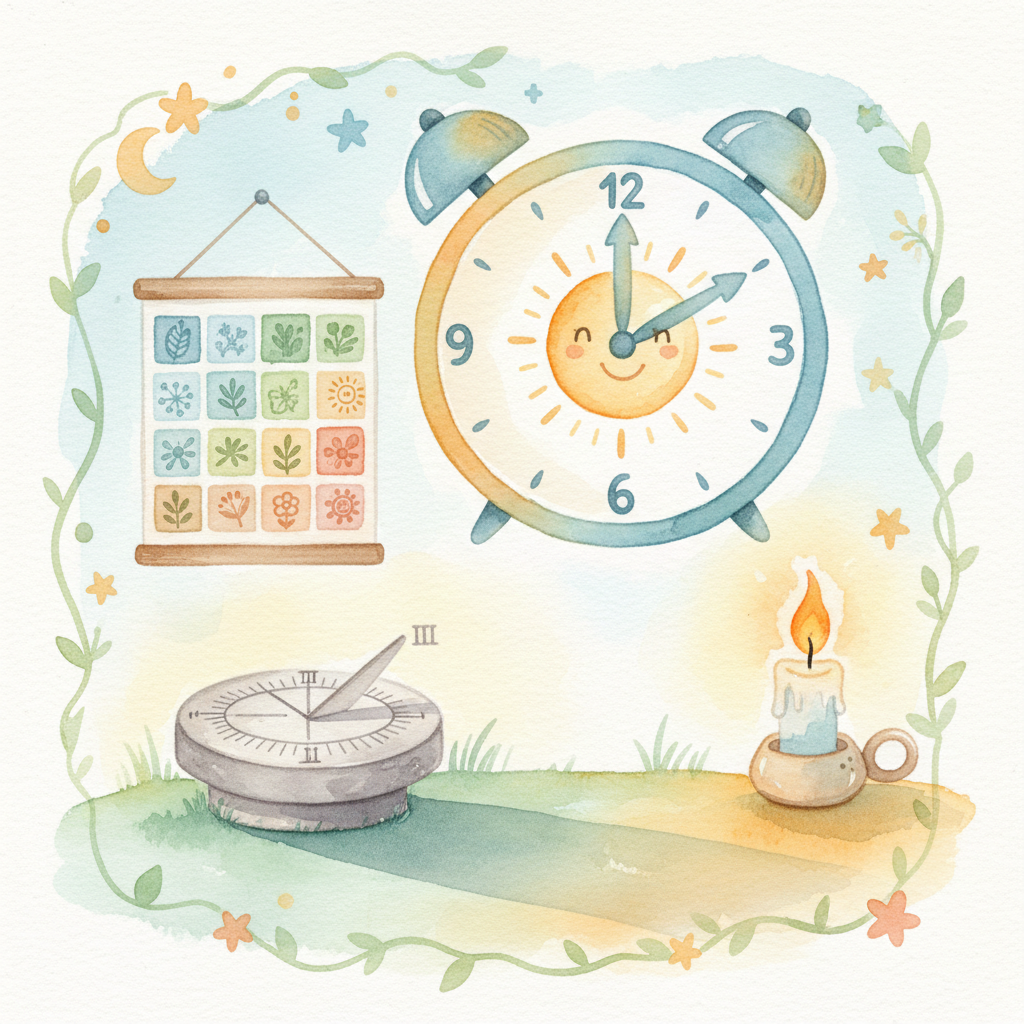
Calendars and Clocks — The Story of Telling Time
...t, t, t the time sound, T makes a tick-tock sound!
What time is it? This simple question has fascinated humans for thousands of years. Astronomy was one of the first ways early cultures marked the passage of time — people could tell by the phases of the moon that time changed. This lesson explores the fascinating history of how we measure time, from ancient sundials to modern clocks, with hands-on activities your child can do at home.
Recommended Materials
- TOOKYLAND Kids Daily Calendar Clock — A Montessori wooden learning toy that includes date, days of the week, months, weather chart, time, and seasons all in one board. Perfect for daily circle time.
- TOOKYLAND Montessori Calendar & Clock — Wooden educational toy for toddlers ages 3+ with moveable hands and sliding date markers.
Free Printouts
This lesson has a rich collection of calendar and clock printables:
Clock Matching Games:
- Clock Face Board 1 (12-5) — Matching game board
- Clock Cards 1 (12-5) — Time tiles to match with the board
- Clock Face Board 2 (6-11)
- Clock Cards 2 (6-11)
- Clock Face Printout — A blank clock face for practice
Calendar & Days:
- Calendar
- Calendar Days and Calendar Days Key
- Weekday Cards and Weekday Names
- Month Cards and Month Names
- Calendar (Spanish) and Calendar (French)
- Birthday Months
The History of Telling Time
Share this fascinating timeline with your child:
The first calendar was a lunar calendar — people observed that the moon changed shape in a regular pattern. A solar year is the time it takes to go from one winter equinox to the next. Ancient people determined the equinoxes and solstices by where the sun rose in the morning. Stone Henge in England and the Mayan pyramids are famous examples of this ancient astronomical knowledge.
Calendars were the earliest invention for keeping track of time in days, weeks, months, and years. Clocks are more complicated — they can keep track of hours, minutes, and seconds.
3500 BC — The first clock was a gnomon or obelisk. The Egyptians placed a stick vertically in the ground, and when the sun hit it, it cast a shadow. By measuring the different shadow positions throughout the day, they could tell the time. It was like a giant sundial! The sundial was even used during biblical times.
Activity 1: Make a Candle Clock
Before mechanical clocks, people used burning candles to measure time. Your child can make their own candle clock! (This activity needs adult supervision.)
What you need:
- A tapered or thick candle
- A candle holder
- A marker or pencil
- A tape measure or ruler
- A watch or timer
Steps:
- Measure the candle's height
- Place the candle in the candle holder
- An adult helps light the candle
- Let the candle burn for exactly 10 minutes (use a timer or watch)
- Blow out the candle, let it cool, and measure how much it burned
- Mark the candle with lines representing 10-minute intervals. To make an hour clock, multiply the measurement by 6 and mark one-hour measurements
- Light the candle again and observe how it helps you tell time!
Discussion: What are the advantages and disadvantages of a candle clock compared to a modern clock? (It can't be used in the wind! And you have to stay nearby to watch it.)
Activity 2: Clock Matching Game
Use our free printable clock boards and cards for a matching activity:
- Print Board 1 and Cards 1
- Cut out the time cards
- Match each card to the correct clock on the board
- When your child masters Board 1, try Board 2 with Cards 2
You can also use these cards to play a Time Bingo game — call out a time and children cover the matching clock on their board!
The Names of Our Days
Did you know our days of the week are named after Roman gods and Anglo-Saxon gods? Here's a fascinating chart to explore with your child:
| Roman | Anglo-Saxon | English | Spanish |
|---|---|---|---|
| Solis | Sun | Sunday | Domingo |
| Lunae | Moon | Monday | Lunes |
| Martis | Tiw | Tuesday | Martes |
| Mercurii | Woden | Wednesday | Miércoles |
| Jovis | Thor | Thursday | Jueves |
| Veneris | Freya | Friday | Viernes |
| Saturni | Saturn | Saturday | Sábado |
Activity: Make vocabulary root word cards for the days of the week and months of the year. Children can discover the connections between the Roman names, the Anglo-Saxon gods, and our modern English day names. Thursday comes from Thor! Friday comes from Freya! Can your child spot the connection between the Spanish days and the Roman names?
Activity 3: Make a Sundial
The sundial is one of the oldest timekeeping devices — your child can make one in the garden!
What you need:
- A straight stick or dowel
- A flat, sunny spot in the yard
- Small rocks or markers
- A watch (to calibrate)
Steps:
- Push the stick vertically into the ground in a sunny spot
- Every hour, place a rock at the tip of the shadow
- After a full day, you'll have a circle of rocks showing the hours
- The next day, use your sundial to tell the time!
Discussion: Why does the shadow move? (Because the Earth rotates!) What happens to your sundial on a cloudy day? This connects beautifully to the Space and Geography lesson about the Earth's rotation.
Connecting Time to the Great Lessons
In Montessori, the concept of time connects to the First Great Lesson — The Story of the Universe. The timeline of the universe, the formation of Earth, and the development of life all happened across vast stretches of time. Understanding how we measure time helps children grasp these enormous scales.
Use our Weekday Cards and Month Cards for daily circle time, and the Spanish and French calendar printouts for bilingual learning!
See also: Lesson 30: Space and Geography for astronomy and the Earth's rotation, and Lesson 28: Earth Science for the geological timescale.
Disclosure: Some links on this page are affiliate links. As an Amazon Associate, MontessoriMom earns from qualifying purchases. This costs you nothing extra.