Lesson of the Day 30: Space and Geography — Astronomy, the Moon, and Latitude & Longitude
Published on: April 02, 2026
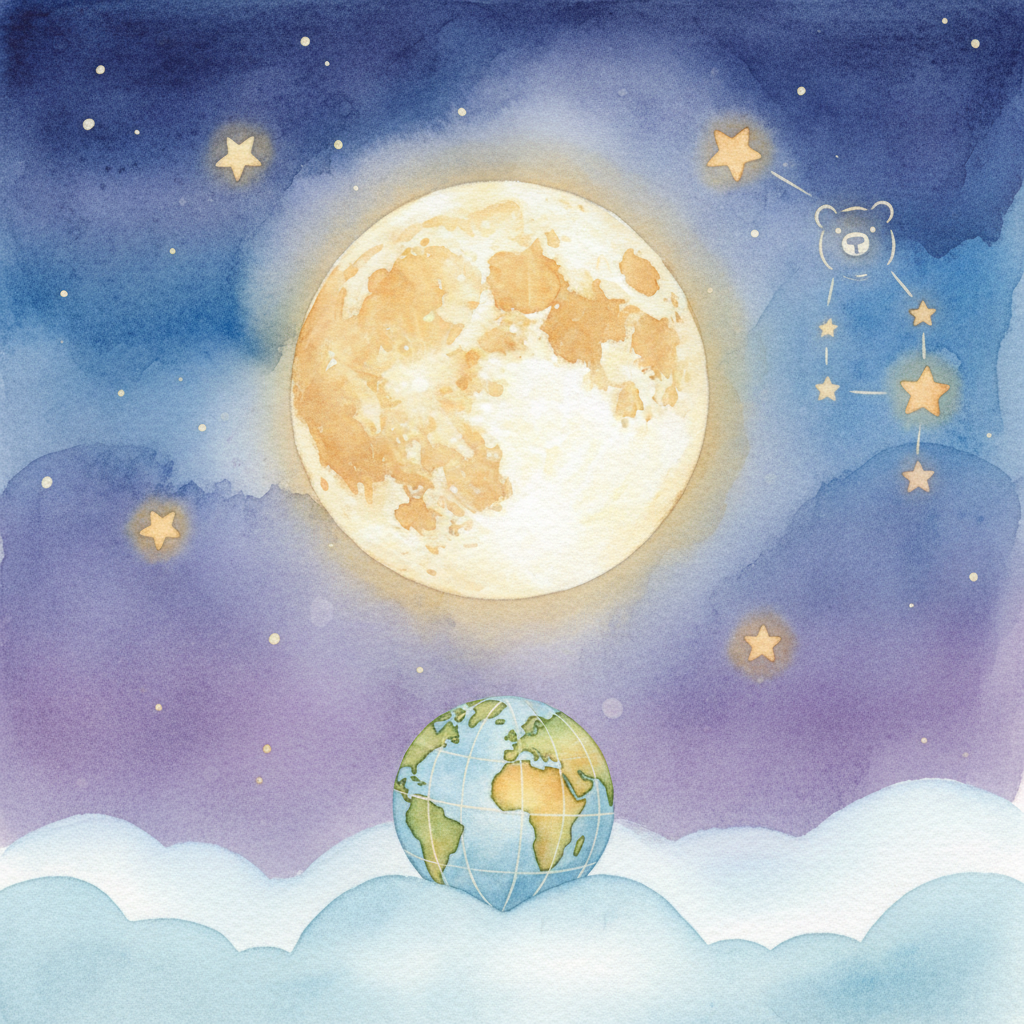
Space and Geography — Astronomy, the Moon, and Latitude & Longitude
...s, s, s the space sound, S makes a star sound!
Looking up at the night sky is one of the most awe-inspiring experiences for children. This lesson combines astronomy (stars and constellations), lunar science (the moon and its phases), and geography (how we measure our place on Earth). All three connect to the Montessori First Great Lesson about the universe's creation and our place in it.
Recommended Materials
- Montessori Solar System Puzzle with Astronauts — Wooden planet puzzle board with 8 planets, astronaut figures, and double-sided solar system flashcards. Hands-on way to learn planet names and order.
- BONNYCO Solar System Felt Board — 61 felt figures including 13 planets, the Moon, Sun, and 46 other space elements. Children build the solar system on a felt board — great for hands-on sequencing and imaginative play.
Free Printouts
This lesson has our richest collection of printable resources — 12 free downloads!
Astronomy:
- Constellation Three-Part Cards — Cards for bright constellations
- Constellation Matching Cards
- Dot-to-Dot: Cygnus and Cassiopeia
- Dot-to-Dot: Orion, Big Dipper, and Little Dipper
Moon Phases:
Geography — Latitude & Longitude:
- Latitude and Longitude Three-Part Cards
- US Map with City Labels
- City Coordinate Cards — Match each card to the city on the map using coordinates
- US Map without Labels — Use coordinates to identify cities
- Blank US Map — Mark cities with a marker, pencil, or push-pin
- Compass Directions
Part 1: Astronomy — Stars and Constellations
Astronomy can be introduced in preschool as a preparation for the Montessori Great Lessons. In the First Great Lesson, the universe's creation is introduced. Later, our solar system is studied more fully, including our sun, the formation of galaxies, and the constellations and their names.
Constellation Activities
For younger children: Constellations can be introduced as a dot-to-dot activity. Use our Cygnus and Cassiopeia dot-to-dot and Orion and the Big Dipper dot-to-dot to connect the stars and see the patterns.
For older children: Study star charts and observe constellations in the night sky without a telescope. On a clear evening, go outside and try to find:
- The Big Dipper — Easy to spot, it points to the North Star
- Orion — Look for the three stars in a row that form his belt
- Cassiopeia — Shaped like a W or M in the sky
Use the Constellation Three-Part Cards for a three-period lesson to learn constellation names.
Recommended books: Find the Constellations by H.A. Rey is a wonderful introduction to the night sky for children.
Part 2: The Moon and Its Phases
The moon is one of the easiest celestial bodies to point out to your toddler. It often appears during daylight hours and is endlessly fascinating to children of all ages.
Moon Phase Observation
The moon has different phases that cycle from new moon to full moon and back. Observe the phases with your child over the course of a month:
- Draw or photograph the moon each night on a calendar or chart
- Use the Moon Phase Cards to match what you see to the correct phase name
- Discuss: Why does the moon appear to change shape? (It doesn't — we're seeing different amounts of the sunlit half as the moon orbits Earth)
Key Vocabulary:
- Perigee — The point where the moon is closest to the Earth
- Apogee — The point where the moon is farthest from the Earth
- The moon's gravitational pull affects our tides and weather!
Montessori Birthday Walk — A New Year Activity
The Montessori birthday celebration is a beautiful way to teach about the Earth's relationship to the sun. The birthday child holds a globe and walks around a candle (representing the sun) — one orbit for each year of their life. You can use this same activity for New Year's celebrations: one walk around represents one year!
For an advanced version, have the child rotate the globe while walking around the sun, showing how the Earth both revolves around the sun and rotates on its axis.
Fun question to explore: Why do we always see the same face of the moon? Because the moon spins at exactly the same rate that it orbits the Earth!
Part 3: Geography — Latitude and Longitude
The earth is a sphere, and we divide it into circles to measure where places are located. This is considered Montessori Culture or traditional Environmental Science.
Longitude
Longitude measures positions east and west. A line of longitude is called a meridian — a straight line along the circumference of the earth from the north pole to the south pole. Each meridian is the same length. The prime meridian passes through Greenwich, England, at 0 degrees longitude.
Latitude
Latitude measures positions north and south. A line of latitude is called a parallel and runs parallel to the equator. The equator is at latitude zero. The north pole is at 90 degrees north; the south pole is at 90 degrees south.
Activities
Balloon Globe: Take a spherical balloon or ball and draw circles representing longitude and latitude on it. Use the Latitude and Longitude Three-Part Cards as a pattern. This makes the abstract concept of coordinates concrete and tactile.
Coordinate Game (3 levels):
- Level 1: Use the labeled US map and city coordinate cards. Match each card to the city on the map and note the longitude and latitude.
- Level 2: Use the map without labels. Students must use coordinates and grid lines to match the label to the point.
- Level 3: Use the blank map and have the student mark cities with a marker, pencil, or push-pin. Use locations that spark your student's interest!
Degrees and Measuring Angles: A circle is divided into 360 parts. One part is called a degree. Each degree is divided into 60 minutes, and each minute into 60 seconds. Understanding how to read an analog clock makes this concept easier to understand — the same 60-minute division applies!
Connecting Space and Geography
Help your child see how all three topics connect:
- Astronomers use coordinates (like latitude and longitude but for the sky) to find stars and constellations
- The moon affects our Earth through tides and weather
- The Earth's tilt and orbit around the sun create our seasons
- Navigation by the stars was how sailors found their way before GPS — connecting astronomy directly to latitude and longitude!
See also: Lesson 28: Earth Science for plate tectonics, volcanoes, and earthquakes — the forces shaping the globe your child is learning to navigate.
Disclosure: Some links on this page are affiliate links. As an Amazon Associate, MontessoriMom earns from qualifying purchases. This costs you nothing extra.