Lesson of the Day 28: Earth Science — Plate Tectonics, Volcanoes, and Earthquakes
Published on: April 02, 2026
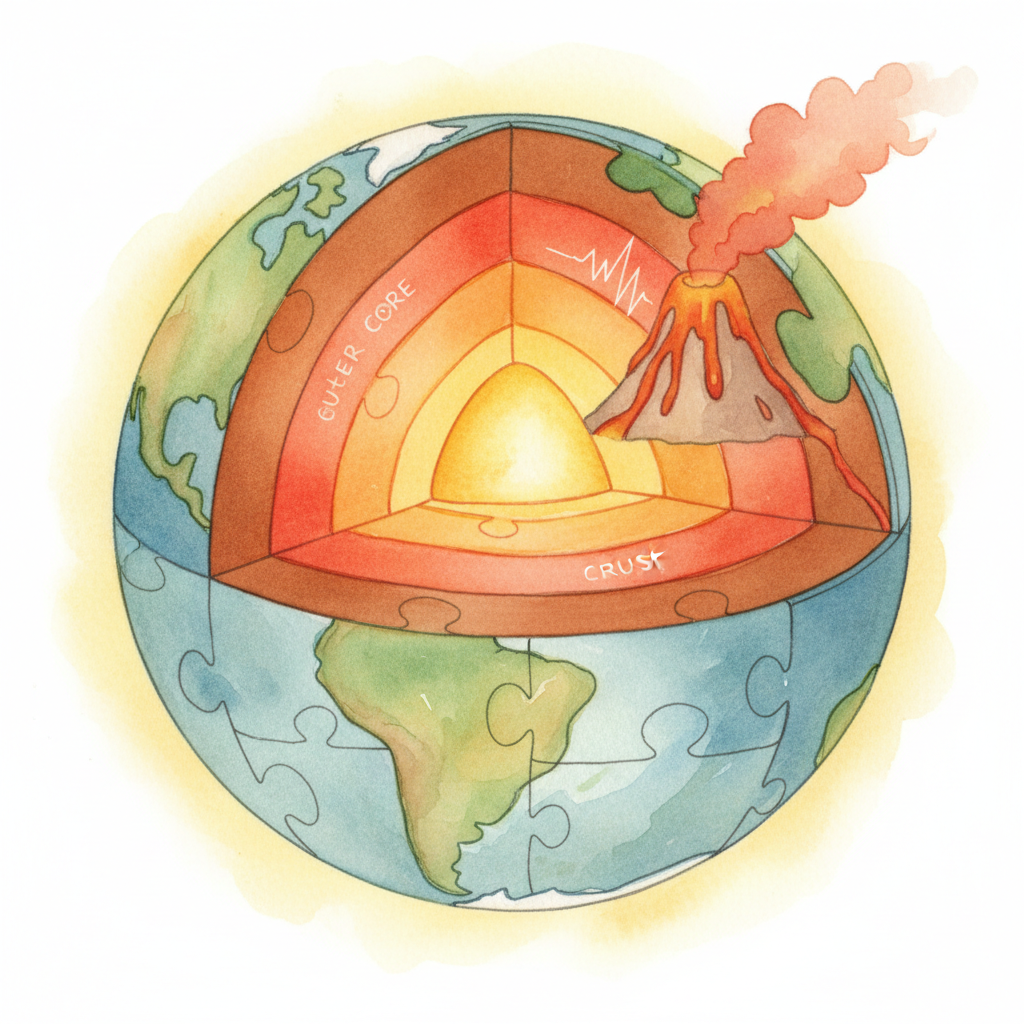
Earth Science — Plate Tectonics, Volcanoes, and Earthquakes
...e, e, e the earthquake sound, E makes an earth sound!
The earth beneath our feet is always moving — usually so slowly we can't feel it, but sometimes dramatically enough to build mountains, create volcanoes, and cause earthquakes. This lesson combines three interconnected earth science topics that connect beautifully to the Montessori First Great Lesson about the formation of the universe and our planet.
Recommended Materials
- National Geographic Earth Science Kit — Over 100 science experiments and activities including building and erupting a volcano, starting a rock collection, water tornadoes, and crystal growing. A comprehensive earth science exploration kit.
- National Geographic Ultimate Volcano Kit — Build and paint a reusable volcano mold, then make it erupt with included materials. A classic STEM project that teaches chemistry, geology, and earth science.
Free Printouts
We have several free printable resources for this lesson:
- Continental Drift Three-Part Cards — Cards showing the different types of tectonic plates for matching and identification exercises.
- Volcano Printout — A diagram of a volcano for labeling and study.
- Earthquake Reading Cards — Reading cards about earthquakes. For younger children, start with the first three cards. Use the three-period lesson to teach new terms.
- Inside the Earth — A cross-section showing the layers of the earth.
Part 1: Plate Tectonics and Continental Drift
The crust of the earth isn't one solid piece — it's made of various plates. Land plates are called continental plates, while plates under the oceans are called oceanic plates.
These plates move very slowly over the surface of the earth. The oceanic plates expand through a process called oceanic spreading — molten rock from the mantle seeps up through cracks in the middle of the oceanic plates. Because of this, the plates on top are also moved, like objects on a conveyor belt. In softer rock, the force shears the rock apart. In harder rock, tension builds up and is released in earthquakes.
When the continental plates move, it is called continental drift. A geologist named Alfred Wegener came up with the theory of continental drift in his book The Origin of Continents and Oceans. He proposed that 300 million years ago, all the continents were joined together in a super-continent called Pangaea. Eventually, it broke apart to form the continents and oceans we know today.
Evidence for Continental Drift:
- Fossils of similar plants and animals have been found on continents that are now separated by oceans
- The continents fit together like a jigsaw puzzle — look at how South America and Africa match!
Three Types of Plate Boundaries:
- Transform boundaries — Two plates slide past each other (like the San Andreas Fault)
- Convergent boundaries — One plate is subducted (pushed under) the other, often creating mountains or volcanoes
- Divergent boundaries — Plates move apart, creating oceanic ridges where new crust forms
Activity: Pangaea Puzzle
Print a world map, cut out the continents, and let your child try to fit them back together into Pangaea. This is a wonderful hands-on way to see how the continents once fit together like puzzle pieces. You can also discuss: What happened to the ancient super-continent Pangaea? It split into two parts — Laurasia (which became North America and Eurasia) and Gondwana (which became South America, Africa, India, Australia, and Antarctica).
Part 2: Volcanoes
Volcanoes erupt because the earth's movement causes openings or vents in the crust. Volcanoes can be mountains, vents, or undersea rifts. Volcanism is an eruption of molten rock at the earth's surface, sometimes with explosive gases and rock fragments.
Key Vocabulary:
- Magma — Soft, molten rock inside the earth's mantle
- Lava — When magma reaches the earth's surface, it is called lava
- The Rock Cycle — Lava cools, hardens, and forms rocks. This is part of the never-ending rock cycle!
- Pacific Ring of Fire — The area around the Pacific Ocean where most volcanoes are located
How a Volcano Erupts:
- Magma presses against the upper mantle from deep within the earth
- The pressure builds until it breaks through to the surface
- Before eruption, there are often several small earthquakes as warning signs
- The combination of magma and water causes a violent eruption
- A big cloud of vaporized water, cinders, and ash rises into the sky
Activity: Make Your Own Volcano
This classic experiment never gets old! Build a volcano from clay or papier-mâché around a small container. When ready to "erupt," add baking soda to the container, then pour in vinegar mixed with red food coloring and a squirt of dish soap. Watch the "lava" foam and flow! Discuss: How is this similar to a real volcanic eruption? How is it different?
Part 3: Earthquakes
The earth is always moving, usually so slowly that we don't notice. On occasions the earth can move very suddenly — this is called an earthquake. Most earthquakes occur in the earth's crust, which covers our earth with layers of rock.
Earthquakes happen when plates below the earth's crust push or pull against each other, causing the rock to fracture or crack. This crack is called a fault.
Types of Faults:
- Strike-slip fault — Rocks on one side try to move past rocks on the other side. Energy builds up like a stretched rubber band, and the rocks snap past each other causing movement.
- Thrust (reverse) fault — The lower level of older rock is pushed above the newer rock.
Earthquake Vocabulary:
- Focus — The point deep underground where the earthquake originates
- Epicenter — The area on the earth's surface directly above the focus
- Aftershocks — Weaker earthquakes that happen after the main earthquake, sometimes lasting for days or weeks
Activity: Earthquake Demonstration
Stack wooden blocks to make a small tower on a table. Have your child gently tap the table — the blocks stay up (small vibrations). Now shake the table more firmly — the blocks tumble (earthquake!). Discuss: Why do some buildings survive earthquakes and others don't? This connects to engineering and the importance of building design.
Connecting the Three Topics
Help your child see how these three topics are all connected:
- Plate tectonics is the big picture — the earth's plates are always moving
- Volcanoes form where plates push together (convergent boundaries) or pull apart (divergent boundaries)
- Earthquakes happen when the stress from moving plates is suddenly released
All three are part of the Montessori First Great Lesson — the story of how our earth formed and continues to change.
See also: Lesson 27: Dinosaurs and Rocks for more geology activities including rock hounding, crystal gardens, and fossil digs.
Disclosure: Some links on this page are affiliate links. As an Amazon Associate, MontessoriMom earns from qualifying purchases. This costs you nothing extra.